Thursday, February 12th, 2026 and is filed under New Mexico Oil and Gas Investing, Oil and Gas Current Events, Oil and Gas Fun Facts, Permian Basin Oil News, Texas Oil and Gas Investing
In 2024, oil continued to serve as a cornerstone of the global economy. While energy diversification efforts expanded in some regions, petroleum and other liquid fuels remained indispensable for transportation, manufacturing, agriculture, and global trade. The world’s Top Oil Producing Countries 2024 continue to exert outsized influence over energy markets, government revenues, and economic stability.
This article examines the eight top oil producing countries in the world in 2024, ranked from highest to lowest based on production of petroleum and other liquids, including crude oil (with lease condensate), natural gas plant liquids, and other petroleum liquids. The rankings and baseline figures follow the Statista chart sourced from the U.S. Energy Information Administration, while country-level discussion references estimated production ranges to reflect real-world variability throughout the year.
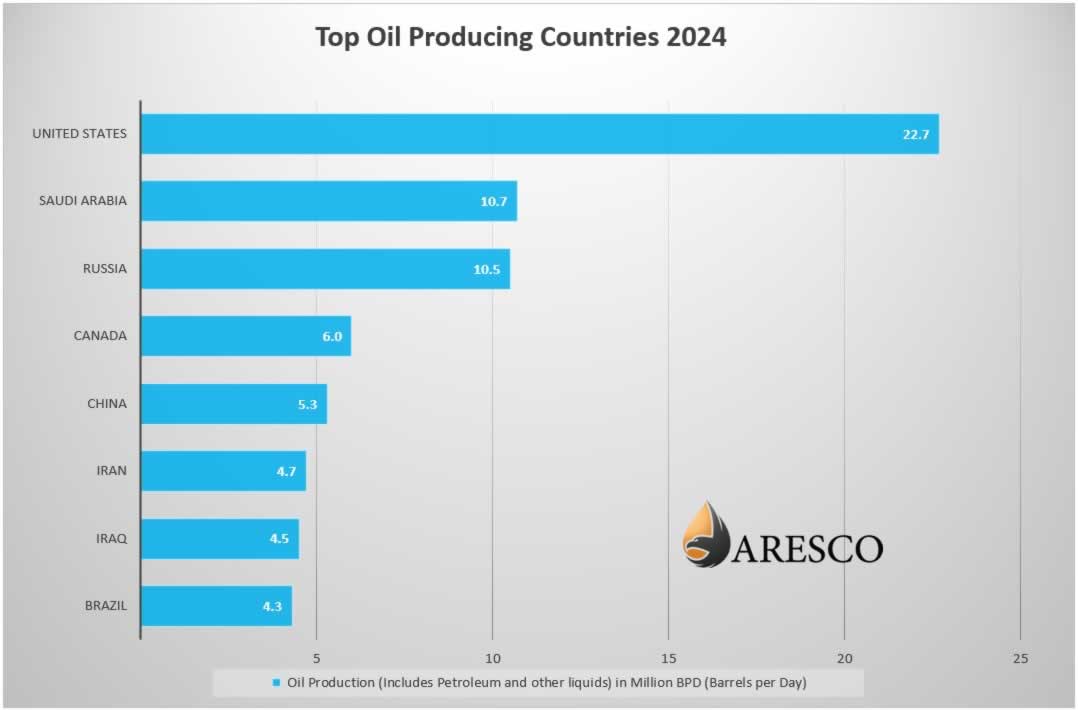
Production figures referenced in this article represent average daily production of petroleum and other liquids during 2024, measured in million barrels per day (bpd).
“Petroleum and other liquids” is a broad category that includes:
The ranking order strictly follows the Statista chart titled “The World’s Largest Oil Producers – Production of petroleum and other liquids in 2024”, sourced from the U.S. Energy Information Administration. Estimated ranges are used within each country’s discussion to reflect production fluctuations, operational constraints, and market conditions during the year.
The United States remained the world’s largest producer of petroleum and other liquids in 2024 by a wide margin, with production generally estimated between 21.5 and 22.9 million barrels per day. This level of output represented roughly one-fifth of total global oil production, underscoring the United States’ dominant role in the global energy system.
U.S. production strength is rooted in the shale revolution, which transformed previously uneconomic resources into prolific producing assets. The majority of petroleum output comes from Texas, New Mexico, and North Dakota, with the Permian Basin alone accounting for a significant share of total volumes. In addition to crude oil, the U.S. produces substantial volumes of natural gas liquids, which materially boost its total petroleum-liquids figure.
Technological advancements in horizontal drilling, hydraulic fracturing, and well completion efficiency have allowed U.S. producers to maintain high output even during periods of price volatility. The country’s vast refining infrastructure and export capacity further reinforce its position as the world’s leading oil producer.
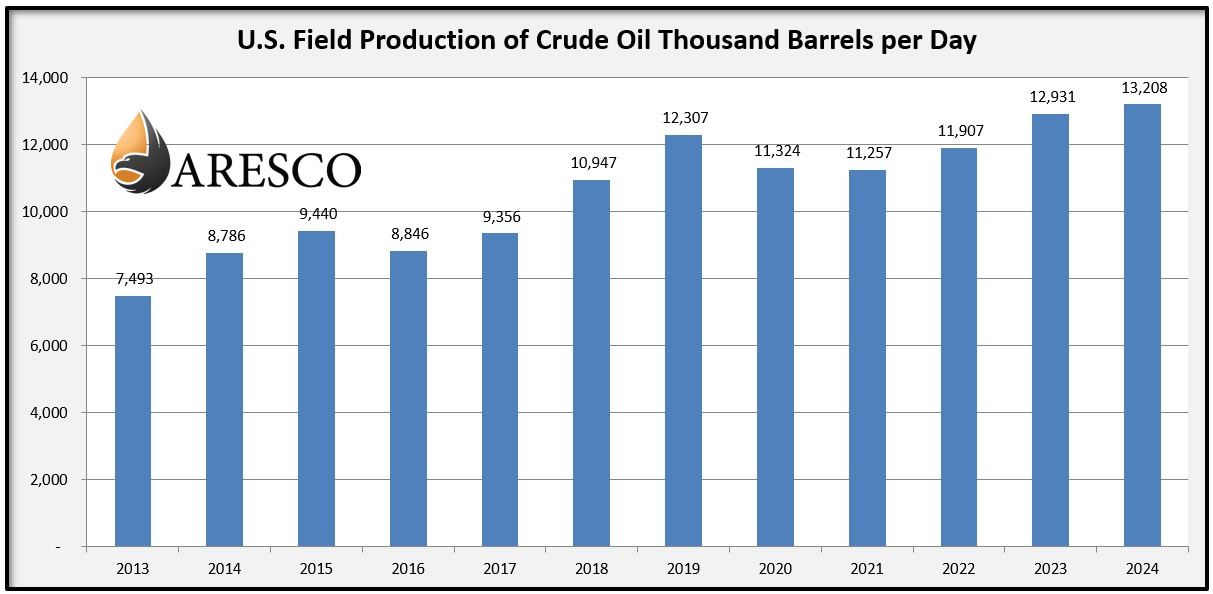
In addition to its leadership in total petroleum and other liquids, the United States also remained the world’s largest producer of crude oil alone in 2024, with production estimated at 13.2 million barrels per day (bpd). This figure reflects crude oil only, excluding natural gas liquids and other petroleum liquids, and represents output from conventional and unconventional sources – including shale plays such as the Permian Basin, Eagle Ford, and Bakken formations. According to the U.S. Energy Information Administration (EIA), this level of crude oil production sustained near record highs throughout the year, driven by continued development of resource-rich basins, ongoing improvements in drilling and completion technologies, and robust global demand. U.S. crude production in 2024 remained higher than any previous annual levels on record, reinforcing America’s position as the dominant global crude oil producer and a major supplier to international energy markets.
Saudi Arabia ranked second globally in 2024, with petroleum and other liquids production typically estimated between 10.0 and 11.0 million barrels per day. Saudi Arabia remains one of the most influential players in the global oil market due to its enormous reserves and its central role within the Organization of the Petroleum Exporting Countries (OPEC).
Oil production in Saudi Arabia is dominated by state-owned Saudi Aramco, which operates some of the world’s largest and lowest-cost oil fields. The kingdom’s ability to adjust production levels relatively quickly gives it significant leverage in managing global supply conditions.
While Saudi Arabia has increasingly emphasized economic diversification, petroleum revenues remain a critical source of government income. The country’s sustained production capacity ensures its continued relevance in global oil markets well into the future.
Russia was the third-largest producer of petroleum and other liquids in 2024, with estimated production ranging from 10.0 to 10.8 million barrels per day. Russia’s oil industry plays a central role in its national economy and export earnings.
Most Russian oil production originates from Western Siberia, though additional output comes from the Volga-Urals region and newer Arctic developments. Despite facing geopolitical pressures and evolving export markets, Russia maintained high production levels throughout 2024.
Russia’s inclusion of condensates and natural gas liquids materially boosts its total petroleum-liquids production, keeping it firmly among the world’s top three producers.
Canada ranked fourth globally, producing an estimated 5.7 to 6.2 million barrels per day of petroleum and other liquids in 2024. Canada’s oil industry is unique in that a large share of its production comes from oil sands rather than conventional reservoirs.
The province of Alberta dominates Canadian oil output, with oil sands projects contributing both crude oil and upgraded synthetic products. Canada also produces significant volumes of condensate and natural gas liquids, which are blended into total petroleum production figures.
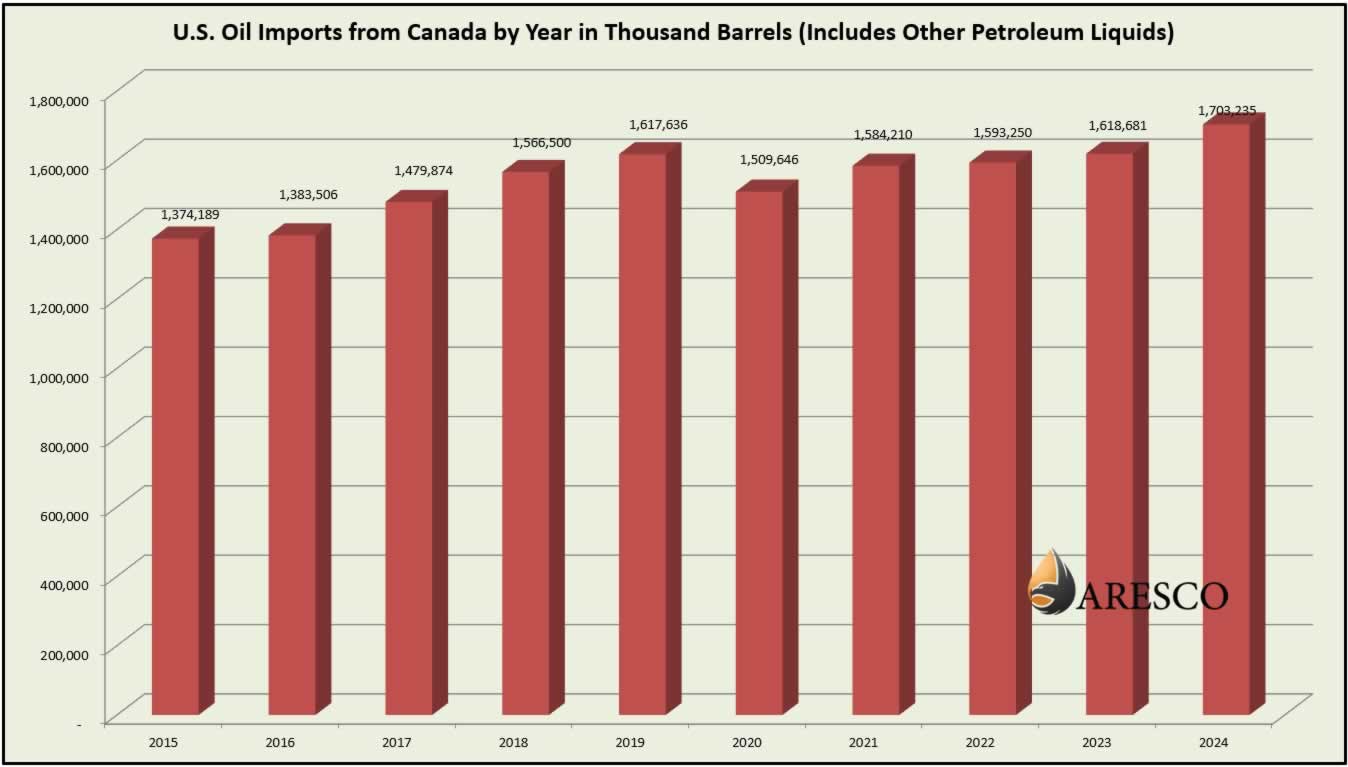
The United States remains the primary destination for Canadian oil exports, making Canada one of America’s most important energy trading partners.
China ranked fifth in global petroleum and liquids production in 2024, with estimated output ranging from 5.0 to 5.6 million barrels per day. China’s domestic oil production is strategically important for several interrelated economic, geopolitical, and national-security reasons, even though China remains one of the world’s largest oil importers.
Chinese oil production comes primarily from mature onshore fields in the northeast and offshore developments in the Bohai Bay and South China Sea. While growth has been modest, China continues to invest in enhanced recovery techniques to slow decline rates in aging fields.
China’s petroleum production provides a measure of energy security and reduces reliance on imports amid global market uncertainty.
Although China is one of the world’s largest oil importers, maintaining domestic oil production remains a strategic priority. Local production helps reduce exposure to supply disruptions along key shipping routes, provides greater flexibility during periods of global market volatility, and supports energy security for China’s industrial economy. Domestic output also works in tandem with China’s strategic petroleum reserves, allowing the country to manage short-term supply shocks without immediately increasing imports. In addition, sustaining production preserves technical expertise and infrastructure, ensuring China retains the ability to scale output if global conditions require it.
Iran was the sixth-largest producer of petroleum and other liquids in 2024, with estimated production between 4.5 and 4.9 million barrels per day. Iran possesses some of the world’s largest proven oil reserves, primarily located in the Persian Gulf region.
Iran’s oil sector remains a major source of government revenue, and its production capacity reflects decades of investment in conventional oil fields. While exports and development have faced external constraints in recent years, Iran’s underlying resource base continues to support substantial output.
The inclusion of condensates and natural gas liquids further elevates Iran’s total petroleum-liquids production.
Iraq ranked seventh globally in 2024, producing approximately 4.2 to 4.7 million barrels per day of petroleum and other liquids. Iraq’s oil sector is the backbone of its economy, accounting for the vast majority of government revenue.
Most Iraqi oil production comes from large southern fields near Basra, which export crude and liquids through Persian Gulf terminals. Despite infrastructure challenges and political complexity, Iraq has maintained steady production levels.
Significant undeveloped reserves suggest that Iraq has long-term production potential beyond current output levels.
Brazil rounded out the top eight in 2024, with petroleum and liquids production estimated between 4.1 and 4.5 million barrels per day. Brazil’s rise as a major oil producer has been driven largely by offshore discoveries in deepwater and ultra-deepwater environments.
Most Brazilian oil production comes from pre-salt fields in the Santos Basin, located far offshore in the South Atlantic Ocean. These fields require advanced drilling and production technology, but they offer high productivity once developed.
Brazil’s offshore success has positioned it as one of the most important oil producers in the Western Hemisphere outside North America.

The global oil market in 2024 continued to be shaped by a relatively small group of dominant producing nations. Together, the eight countries highlighted in this article accounted for a substantial share of total world petroleum and other liquids production, reinforcing oil’s ongoing importance to the global economy.
Production levels varied throughout the year due to operational factors, market conditions, and geopolitical developments, but the overall rankings remained consistent. The United States maintained a commanding lead, followed by Saudi Arabia and Russia, while Canada, China, Iran, Iraq, and Brazil formed a powerful second tier of producers.
Despite ongoing discussions around energy transitions, petroleum and other liquid fuels remain deeply embedded in the global economic system. As long as transportation, manufacturing, and industrial activity depend on liquid fuels, the world’s largest oil-producing countries will continue to play a defining role in shaping global markets.
Start the New Year Right by Lowering Your Taxable Income with Oil and Gas Investments
This is not an offer to sell nor solicitation of an offer to buy any security. Such offer may only be made by a written prospectus in a jurisdiction wherein the offering is duly registered or exempt therefrom. This content is provided for informational purposes only. Nothing herein shall be construed as tax, legal, or accounting advice. Investing in oil and gas is highly speculative and could result in substantial losses. There are no guarantees that any returns will be achieved. Potential investors should consult their attorney, accountant, and financial advisors before investing in oil and gas.



© Copyright 2026 Aresco, LLC. All rights reserved. | Privacy Policy | Admin Log in
